Successfully Implementing MRM Solutions – A Practical Guide
Lisa Burow
Lisa Burow
Senior Consultant
Lisa advises clients with a focus on customer engagement, marketing, CRM, and web tracking data. Her expertise includes the implementation of marketing automation and marketing resource management solutions, as well as the design and delivery of cloud-based solutions for connecting, processing, and integrating standard marketing platforms. Working closely with clients, she leverages her marketing and technology expertise to develop tailored, resilient, and scalable solutions.
In this guide, you will learn how to efficiently implement an MRM solution in your organization. From analyzing your needs, existing processes, and requirements through to ongoing development, you will discover how to make your marketing team more efficient and successful step by step.
Table of Contents
Marketing departments today face the challenge of coordinating an ever-growing number of channels, processes, and content types—often under significant time pressure and with limited resources. This is exactly where an MRM solution demonstrates its strengths: it creates structure, simplifies workflows, and helps you bring transparency and efficiency to your marketing operations.
Our guide shows you what really matters when introducing an MRM solution—from selecting the right software and running a proof of concept (PoC) to implementation. We support you step by step on your journey toward a future-proof system.
Why Thorough Preparation Is Crucial
In the dynamic world of marketing, clear organizational structures and well-defined processes are essential. Marketing Resource Management (MRM) helps teams plan, coordinate, and measure activities. At the same time, it ensures that all stakeholders can collaborate simultaneously on the same documents.
MRM systems consolidate marketing resources, budgets, campaigns, content, and digital assets in a single central location.
However, successful implementation in an enterprise environment requires more than simply introducing a new tool. What truly matters is an approach that seamlessly combines organizational, technical, and cultural aspects. Below, you will find a straightforward guide to successfully integrating an MRM solution.
1. Analyze Existing Marketing Processes
Before selecting a new solution, you should take a close look at how your current processes work. Where do manual steps exist that could be simplified through automation? Which approval processes take too long? How well does content creation work across different departments?
A detailed review of your entire content and campaign production process reveals where optimization potential lies—both in organizational structures and in the management of marketing resources and budget allocation. A solid assessment of the current state makes later integration into existing systems much easier and ensures that you can manage your marketing activities in a more structured way in the future.
2. Clearly Define Requirements
Define the goals you want to achieve with the solution: Do you want to improve collaboration, manage marketing budgets more transparently, increase efficiency, or gain clearer insights into the ROI of your marketing campaigns?
Both functional requirements (e.g., content management, reporting, workflow automation) and non-functional requirements such as scalability or system performance play an important role. The solution should support standardized processes without limiting team flexibility. Clearly defined objectives form the foundation for selecting the right MRM software.
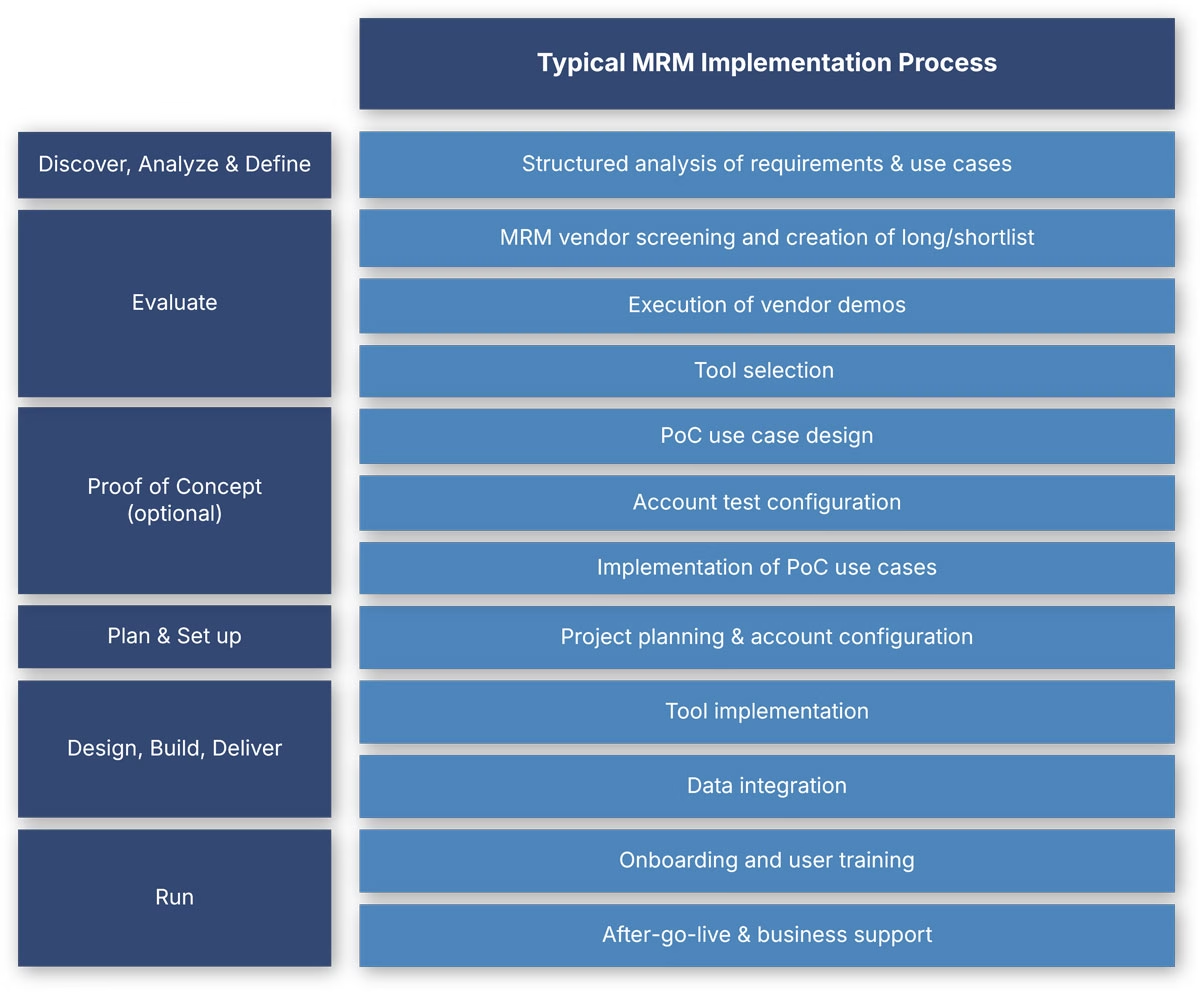
Typical MRM implementation process
Step by Step Toward a Successful MRM Implementation Project
Once the current state and requirements for the new solution are clearly defined, you can begin the actual implementation project.
3. Select the Right MRM Solution
There are various MRM systems on the market, each offering different functionalities. Make sure the solution aligns with your strategic goals and fits into your existing tool landscape. Compare all available options and evaluate usability, technical support, and customization capabilities.
Powerful providers not only manage content and assets but also enable better control of marketing strategies, more efficient workflows within the marketing department, and clearly defined KPIs to measure success.
A PoC is highly recommended to test the solution in your specific environment. It shows how well your requirements can be implemented in practice. Many vendors offer a test instance where you can check whether your workflows can be mapped seamlessly, identify benefits, and determine where adjustments are needed.
This approach reduces project risk and provides early insights into usability and functionality.
5. Identify and Train Product Owners
Clear internal ownership of the system is critical. You should appoint a dedicated internal team or responsible individual who receives comprehensive training during the implementation phase.
Product owners need to understand both the technical background and the functional requirements of the marketing teams. After implementation, they should not only operate and maintain the MRM solution but actively develop it further. This ensures that changing business or market requirements are anticipated in time and that the solution is used sustainably and delivers maximum value.
6. Implement Together With the Team
The earlier you involve your team, the greater the acceptance during daily operations. Training sessions, clearly defined roles, and a shared understanding of the system’s benefits help ensure a smooth transition from manual processes to efficient, digitally supported workflows.
a) Configuration
Initial base configurations are created together with the product owners.
b) Define Forms & Processes
Together with the individual marketing departments, requirements for briefing forms and processes are clarified and defined.
c) Testing & Adjustments
Before go-live, departmental requirements should be tested iteratively with a small group of power users, allowing adjustments to be made as needed.
d) Training
A key element of introducing a new MRM solution is organizing training sessions for different user types, ensuring that all users can quickly become familiar with the new tool.
7. Go-Live
At a defined point in time, the new solution goes live for all users. Plan a hyper-care phase afterward, as well as regular tool consultation sessions to provide space for questions and support in case of issues.
Continuous Development and Integration of MRM: The Key to Adoption
After a successful implementation, it is essential to continuously develop both the system and its configurations. Marketing operations are highly dynamic, and the tool will only maintain a high level of acceptance if you remain flexible, make ongoing adjustments, and continuously explore new opportunities and use cases.
8. Operations and Ongoing Development
Further expansion includes integrating the MRM solution into the existing system landscape. This enables direct communication between planning and campaign execution, eliminates duplicate maintenance of campaign metadata, and allows reports to be generated automatically.
Regular user feedback helps identify where processes can be further improved. This includes:
deeper integration into the existing tool landscape
better alignment between systems and data sources
expanded management of digital assets
support for new formats or channels in modern marketing
A clearly structured project management approach helps you plan and implement these development steps effectively.
Get inspired and discover more valuable articles about Marketing Resource Management in our comprehensive MRM blog series:
If you want to manage and optimize your marketing activities more efficiently, we are happy to support you in implementing a suitable Marketing Resource Management solution. Together, we create a platform that makes the best possible use of your marketing resources and strengthens your competitiveness in the long term. Feel free to contact our MRM experts for a non-binding consultation.
Want To Learn More? Contact Us!
Your contact person
Harald Mösel
Management Consultant
Who is b.telligent?
b.telligent – that’s Data Analytics, AI, Customer Engagement, and Data Visualization. It’s Germany, Austria, Switzerland, and Romania. But most importantly, it’s our team: people with a true passion for data, working together to create innovative solutions that drive sustainable progress for businesses.
Which architecture is right for your business? Using Zeotap as an example, we explain the difference between zero-copy access and a native Snowflake integration.
Composable customer data platforms (CDPs) have long been more than a marketing term, but not every composable CDP works the same way. Some access a company’s Snowflake data via zero-copy, while others run entirely natively within the company’s own account. Using Zeotap as an example, this article explores what distinguishes these approaches from both a technical and strategic perspective. By the end, you will understand which architecture is best suited to which use case—and what to consider during procurement.
An integrated Marketing Resource Management (MRM) solution is far more than just another tool in the system landscape. It becomes your central platform for managing and efficiently utilizing marketing resources, digital assets, budgets, campaigns, content, and approvals in one place. This significantly improves transparency, quality, and the ROI of your marketing activities. In this article, we outline different paths to successful integration and help you identify the best solution for your specific needs.
Lost between parallel campaigns, scattered data, and rising expectations? Discover how Marketing Resource Management (MRM) gives you clarity, control, and efficiency through one central platform. Turn chaos into measurable success.