Lisa advises clients with a focus on customer engagement, marketing, CRM, and web tracking data. Her expertise includes the implementation of marketing automation and marketing resource management solutions, as well as the design and delivery of cloud-based solutions for connecting, processing, and integrating standard marketing platforms. Working closely with clients, she leverages her marketing and technology expertise to develop tailored, resilient, and scalable solutions.
An integrated Marketing Resource Management (MRM) solution is far more than just another tool in the system landscape. It becomes your central platform for managing and efficiently utilizing marketing resources, digital assets, budgets, campaigns, content, and approvals in one place. This significantly improves transparency, quality, and the ROI of your marketing activities. In this article, we outline different paths to successful integration and help you identify the best solution for your specific needs.
Table of Contents
Learn how a fully integrated MRM solution helps you optimize your end-to-end marketing processes, reduce redundant tasks, simplify team collaboration, and maintain full visibility at all times—using effective integration methods for maximum impact.
Why Full Integration Is Crucial
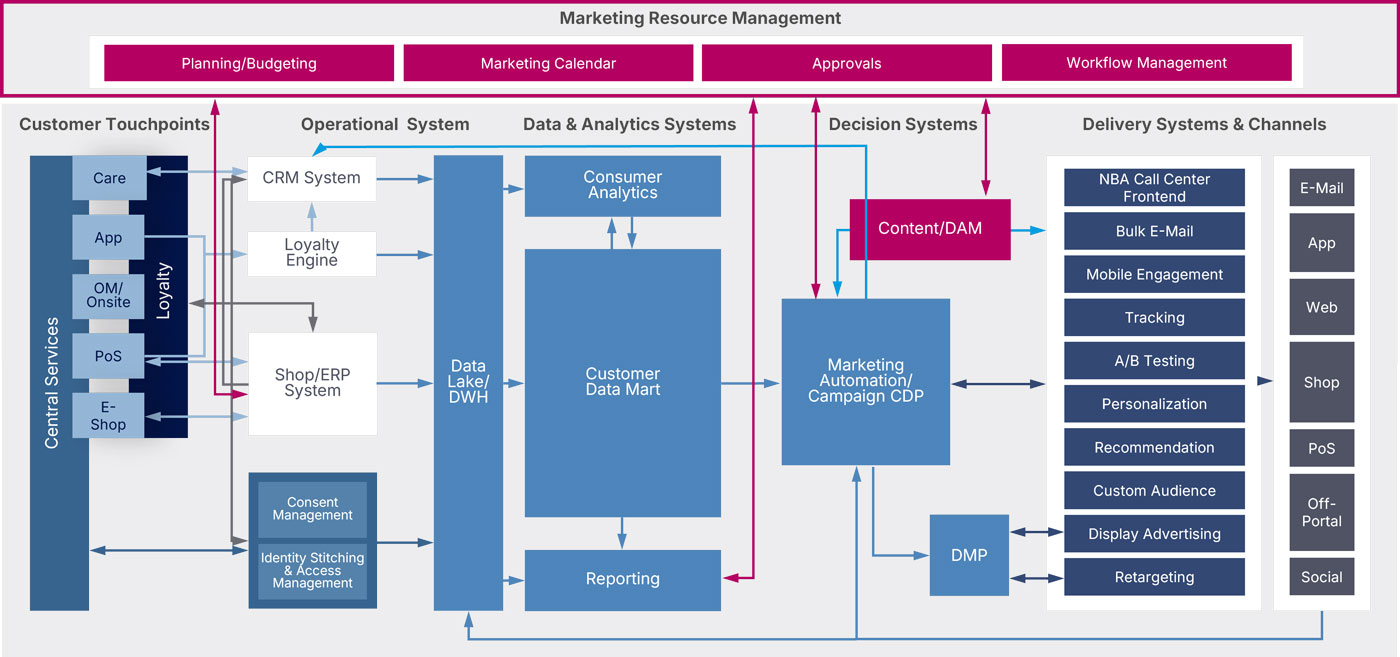
Many companies initially implement and operate an MRM system as a standalone tool within the marketing department. While the benefits quickly become apparent, it soon becomes clear that without integration with other systems—such as CRM, Digital Asset Management, Marketing Automation, or ERP—unnecessary duplicate work arises. Why? Because data has to be maintained multiple times, approval processes take longer, and marketing teams lose valuable time that would be better spent on strategy and creative work.
In this guide, you will learn how to ensure the successful implementation of an MRM solution.
A fully integrated MRM solution means that the Marketing Resource Management system is seamlessly connected to other systems and platforms within the organization. This typically includes both technical data integration and functional process integration. Overall, a fully integrated MRM solution offers several key benefits:
Key Benefits at a Glance
1. Less Manual Work, Fewer Errors
Redundant data entry is eliminated. Workflows and processes are automated, reducing errors and freeing up valuable capacity.
2. Improved Data Transparency
All information related to campaigns, budgets, assets, content, and approvals is centrally available—providing a major advantage for reporting, planning, and control.
3. Optimized Collaboration
Marketing teams can work in a more structured way, both internally and across departments. Everyone can see what has already been completed and where decisions are still required.
4. Automated Workflows
From approval processes to campaign planning, automation ensures smooth operations and faster response times.
5. Increased Flexibility
Adjustments to changing business requirements can be implemented more easily, as the MRM system is an integral part of the overall IT infrastructure.
6. Consistent Campaign Management
By synchronizing planning and execution tools through MRM, you ensure consistent messaging and customer engagement across all channels.
7. Comprehensive Reporting
Consolidated data enables deeper analysis—covering campaign performance as well as the optimization of marketing activities and budgets.
All of these factors contribute to maximizing the effectiveness and value of your marketing initiatives.
b.telligent MarTech-Architektur
How an MRM Solution Can Be Integrated
Companies differ in their IT landscapes—and integration approaches can be just as diverse. The following three integration strategies have proven particularly effective:
1. Using Standard Connectors
With the help of standard connectors, you can integrate an MRM solution easily and efficiently into an organization’s existing system landscape. These connectors are prebuilt integration interfaces that can be implemented quickly to connect popular business applications—such as CRM, ERP, or marketing automation tools—with the MRM solution. The key advantage of this approach is fast deployment and easy maintenance, as connectors are often developed and updated directly by the software vendors. This allows you or your organization to benefit from standardized integration with minimal development effort.
2. Using Middleware
Middleware acts as an intermediary between the MRM solution and other internal enterprise systems. With such a solution, you can connect different applications via a central platform that optimizes data exchange and process flows. Middleware enables automated and transformed data flows, ensuring that information is transferred consistently and efficiently across systems. This approach is particularly suitable for organizations with complex IT landscapes, as it offers a flexible and scalable integration method that can easily adapt to changing requirements.
3. API Integration as a Custom Solution
API integration using a custom-built solution provides a tailored approach to integrating an MRM system. In this case, custom interfaces are developed to precisely match the specific needs of your organization. This method offers maximum flexibility and allows individual business logic and processes to be seamlessly integrated. However, it requires greater development effort and technical expertise. This approach is ideal for organizations with unique requirements that cannot be fully addressed by standard solutions or middleware.
Learn how b.telligent implemented a custom API integration using the MRM software Marmind in combination with a GCP project in this success story: OTTO Success Story
Conclusion: Why Marketing Resource Management Is Essential Today
Modern marketing departments must manage budgets, campaigns, content, digital assets, and teams simultaneously. An integrated MRM solution brings structure, connects systems, automates recurring tasks, and ensures that your entire marketing operation is managed effectively. The result: greater focus, better structure, and stronger impact.
Get inspired and discover more valuable articles about Marketing Resource Management in our comprehensive MRM blog series:
Are you looking to integrate MRM into your system landscape and searching for a solution that truly advances your marketing processes? We are happy to support you—from analysis and integration through to successful implementation. Contact our MRM experts and start your MRM transformation today.
Want To Learn More? Contact Us!
Your contact person
Harald Mösel
Management Consultant
Who is b.telligent?
b.telligent – that’s Data Analytics, AI, Customer Engagement, and Data Visualization. It’s Germany, Austria, Switzerland, and Romania. But most importantly, it’s our team: people with a true passion for data, working together to create innovative solutions that drive sustainable progress for businesses.
Which architecture is right for your business? Using Zeotap as an example, we explain the difference between zero-copy access and a native Snowflake integration.
Composable customer data platforms (CDPs) have long been more than a marketing term, but not every composable CDP works the same way. Some access a company’s Snowflake data via zero-copy, while others run entirely natively within the company’s own account. Using Zeotap as an example, this article explores what distinguishes these approaches from both a technical and strategic perspective. By the end, you will understand which architecture is best suited to which use case—and what to consider during procurement.
In this guide, you will learn how to efficiently implement an MRM solution in your organization. From analyzing your needs, existing processes, and requirements through to ongoing development, you will discover how to make your marketing team more efficient and successful step by step.
Lost between parallel campaigns, scattered data, and rising expectations? Discover how Marketing Resource Management (MRM) gives you clarity, control, and efficiency through one central platform. Turn chaos into measurable success.