Cluster AI Use Cases Instead of Collecting Them: Mise en Place for Proof of Value
Lennart Werner
Lennart Werner
Data Strategy Solution Lead
Experienced Data Strategy Consultant with over 10 years of expertise in data management and the development of comprehensive data, analytics, and AI strategies. Focus on Business-oriented Data Strategy, where data-driven potentials are systematically identified and realized through targeted enablers from the areas of People and Technology. Extensive experience in collaboration with business units, IT, and top management, as well as in the pragmatic implementation of strategic initiatives into measurable business value.
AI use cases can be collected quickly, but prioritizing them is what determines their actual value. Learn how to cluster ideas effectively, build strategic capabilities, and establish a sound starting point with a Proof of Value.
Table of Contents
Companies across industries are asking which AI use cases truly create strategic value. Especially in mid-sized companies and larger organizations, data and AI workshops often generate a wealth of ideas in a short time—from integrated enterprise reporting and automated invoice verification to knowledge chatbots.
There is one moment we experience in nearly every one of these workshops: After two hours, 30 or 40 potential use cases are posted on the wall. The mood is great. But then someone asks the crucial question: “Great. So where do we start?”
This is the point at which it becomes clear whether an energetic workshop will lead to a viable data and AI journey—or simply result in a photo of sticky notes. Identifying AI use cases is not enough. The key is to structure them in a way that creates a solid basis for decision-making in your digital transformation.
This article shows you how to move from a cloud of ideas to a concrete starting point: using a potential map, clustering, use-case streams, and a Proof of Value. In short: the mise en place for your AI roadmap.
Step 1: Collect AI Use Cases and Position Them on a Potential Map
The first mistake is to treat use cases as a flat list. A list can only be discussed one item at a time. As a result, the idea advocated most loudly can easily win out—not necessarily the use case with the greatest potential.
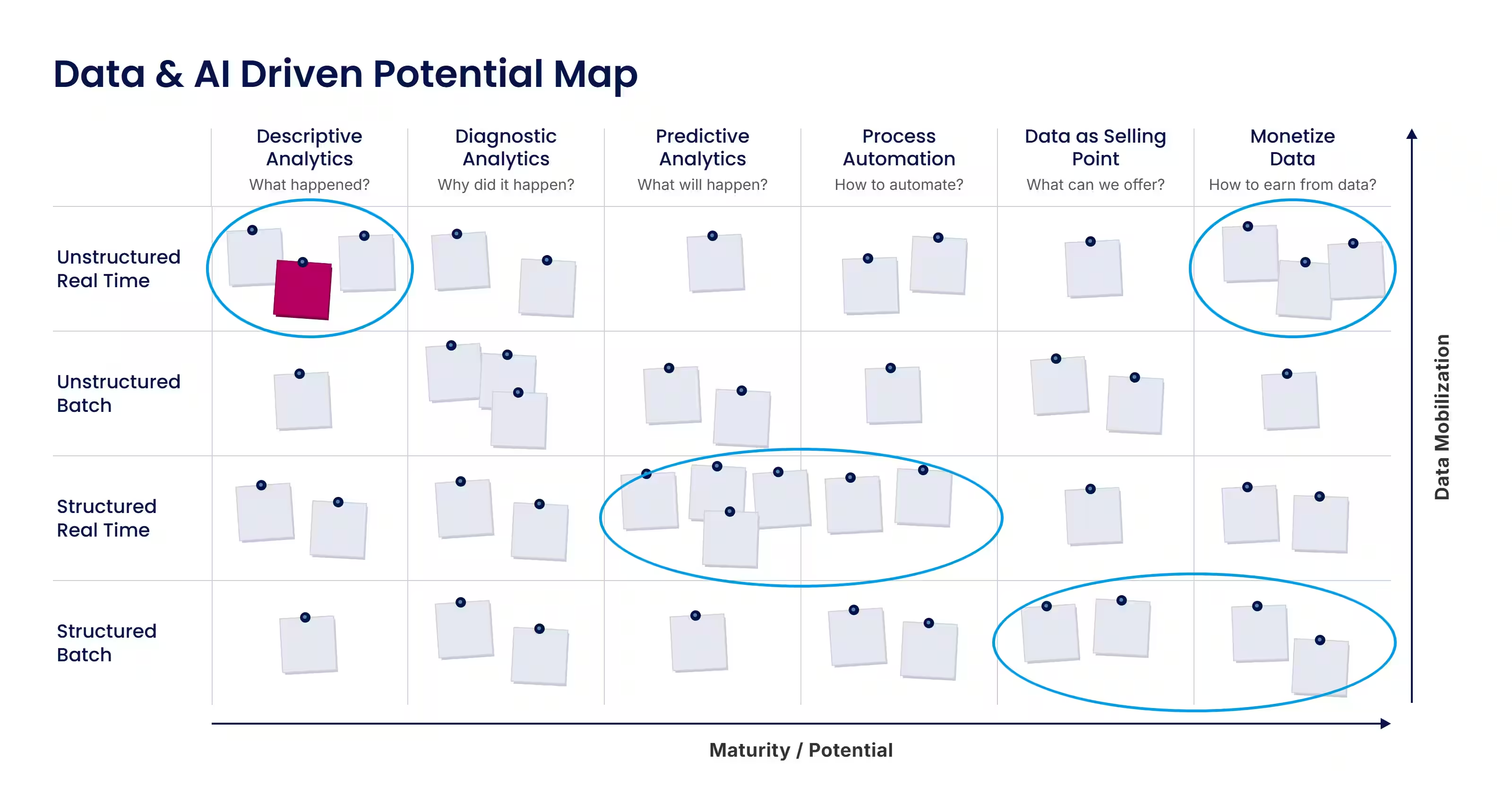
A better approach is to position every idea on a two-axis map, known as a potential map. It helps bring AI applications, traditional data analytics initiatives, and potential automation initiatives into a shared context.
Using the kitchen analogy, the roles can be clearly separated. The menu represents the business. The business leads, while people and technology enable it. Both need to come together from the outset—and the potential map is the tool for doing exactly that.
In a data and analytics context, we use one axis to represent the maturity of the potential:
Descriptive Analytics: What happened?
Diagnostic Analytics: Why did it happen?
Predictive Analytics: What will happen?
Process Automation: How can we automate the process?
Monetizing Data: How can data be used as part of a product or as a standalone product?
The other axis represents data mobilization: Does the use case require structured batch data from ERP and CRM systems? Or does it focus on unstructured documents, images, emails, and other data sources? Does processing need to happen in batches or in real time?
For portfolios with a strong artificial intelligence focus, an additional map can be useful. Its axes are AI capability and degree of autonomy. AI capabilities may include language, analysis, generation, perception, personalization, or automated process steps. The degree of autonomy ranges from “AI informs” and “AI assists” to “AI recommends, human confirms” and clearly defined autonomous decisions.
This classification creates transparency, especially when using AI technologies such as generative AI, LLMs, or machine learning: Where is human review required as part of a human-in-the-loop approach? Where can processes become more automated over time?
Why is this effort worthwhile? Because AI use cases located in the same area of the map often share implementation requirements. Two dashboards based on structured ERP data require similar data connections, master data, and platform foundations. A document extraction use case and a RAG-powered knowledge chatbot, on the other hand, share the capability to make unstructured content accessible and usable.
The map makes visible what a simple list conceals: synergies, dependencies, and reusable technology capabilities.
Step 2: Build Clusters: Turn Many AI Use Cases Into Strategic Themes
Now comes the crucial step: Look at the populated map and form clusters of ideas with similar requirements. Every professional kitchen demonstrates how effective this principle can be: The saucier is responsible for meat and sauces, the entremetier for side dishes, and the pastry chef for desserts. Each station brings together the equipment, processes, and mise en place shared by the dishes in its area.
These are exactly the kinds of stations you are looking for on your map, because they show which enablers your menu truly requires. In practice, a small number of natural thematic areas often emerge.
Analysis and Diagnostics
This cluster includes reporting and controlling use cases based on structured data, such as enterprise reporting, sales performance, or procurement dashboards. Their common denominator is an integrated, reliable data foundation that spans system boundaries.
Forecasting and Opportunity Analysis
This category includes forecasting, customer value scoring, supply chain forecasts, and the analysis of sales data and market trends. The cluster builds on a robust data foundation and enhances it with modeling and data science expertise. AI models can help predict developments and identify patterns in data early on.
Document Automation and Agentic AI
Incoming invoices, order confirmations, and document verification typically belong in this cluster. Their common denominator is the ability to understand unstructured documents, extract information, reconcile it with existing data, and execute defined follow-up steps.
Depending on the specific process, these AI-powered solutions can reduce routine work and relieve teams of manual effort. Governance, roles, and clear guardrails for AI systems remain essential prerequisites.
Knowledge Access and Conversational AI
This cluster centers on chatbots and assistants that access enterprise knowledge. One example is an internal chatbot for customer service or business functions that makes information from dispersed sources easier to find. RAG can help connect language models with relevant internal company content.
A robust authorization model, content quality assurance, and integration with existing IT systems are key aspects of AI integration in this area.
This turns 30 competing individual ideas into just a few strategic themes. The discussion changes fundamentally. Instead of asking which individual use case should win, the better question is: Which capability should we build first, and which additional AI use cases will it enable?
Two important caveats apply. First, the clusters should follow shared requirements—not the organizational chart. If you create a separate cluster for every department, you have simply made the list look nicer. Second, a circle on the map is not yet a station in the kitchen. It identifies the shared requirement; it does not build it. Establishing the first integrated data foundation remains a significant undertaking.
Clustering transforms 30 individual ideas into a small number of strategic themes with shared requirements.
Step 3: Move From Clusters to Streams—Build Capabilities, Not Individual Projects
Each cluster now becomes a use-case stream: a workstream with a specific initial use case, a clear focus, and named stakeholders.
The central idea is this: A stream does not only deliver its first use case. It establishes a capability that enables additional use cases within the same cluster.
When the analytics stream builds its first integrated dashboards, it also creates data connections, master data logic, and governance. Every subsequent analysis benefits from these foundations. When the document stream automates invoice verification, it establishes a reusable capability for extracting and reconciling information. The next document use case can build on it.
The same applies to other areas: Anomaly detection, for example, can build on shared data and monitoring foundations. Predictive maintenance and asset control likewise require robust integration of data, models, and operational workflows. The specific application depends on the industry, but the underlying capabilities can be reused across multiple initiatives.
This is why it is worth deliberately distributing streams across the potential map. Each stream opens up a different area. Together, they create the foundation for a scalable portfolio of AI solutions.
Step 4: Prioritize AI Use Cases and Create Commitment
The central question remains: Which stream should start first?
This is where sound methodology separates itself from wishful thinking. The mechanism matters more than any individual scoring formula. During use-case analysis, the expected value is captured systematically: What outcome is expected? At what scale? How will it be measured?
This assessment should not be carried out by external consultants alone. Business leaders and the relevant business function should evaluate the benefits of their own use cases. That is a key advantage of a structured requirements engineering and prioritization process: It creates ownership and commitment.
Those who have assessed the value of their own use case are more likely to support the initiative later on. Ownership begins during evaluation—not at kickoff.
At the same time, the business should not have to determine costs on its own. The effort required for the AI applications, along with the allocated costs of the necessary enablers—such as the platform, data connectivity, governance, or software development—can be made transparent by an implementing data team or consulting partner.
This creates a clear value-cost profile for every use case. The potential map becomes a prioritized portfolio. The result is often a phased rollout: One or two streams begin immediately, while others follow in later horizons once the necessary foundations are in place.
Step 5: Start With a Proof of Value
That leaves the question of the very first step. Our clear recommendation is to start with a Proof of Value (PoV)—not just a Proof of Concept.
A Proof of Concept asks, “Is this technically feasible?” For many AI-related technology questions, that is often no longer the deciding factor today. A Proof of Value, on the other hand, asks, “Does this solution create measurable value for us, and can we use the capability sustainably afterward?”
That is the question on which budgets, trust, and the next stage of transformation depend.
A Proof of Value demonstrates its value in day-to-day operations and leaves capabilities with the team.
A strong PoV takes on one or two prioritized AI use cases from the initial streams and pursues three goals at the same time:
Demonstrate Value
The use case is implemented in production and measured against specific metrics. These may include verification time per document, error rates, conversion rates, or incremental revenue per segment. The goal is not a demo video, but tangible value in day-to-day operations.
Build Reusable Capabilities
Platform components, data products, APIs, and standards should be designed so that additional AI applications can build on them. This means the foundation for an AI factory is not created only after the first project—it starts taking shape during the PoV itself.
Embed Enablement Within the Organization
The often underestimated element of a Proof of Value is enablement. A PoV in which a service provider leaves afterward, taking its knowledge with it, remains rented expertise. A more sustainable approach is joint delivery in tandem: through pairing, training, documented decisions, and a structured handover.
Ideally, the result is a team that can independently implement or confidently manage similar AI use cases in the future. External expertise can then focus on new, more complex topics, such as advancing data engineering, machine learning, or integrating additional AI models.
The Whole Approach in One Sentence
The path from a wall full of sticky notes to a running system can be summarized as follows: Collect, position, cluster, translate into streams, prioritize with commitment, and start with a Proof of Value that demonstrates value and leaves lasting capabilities behind.
The cloud of ideas is never the problem. It is the raw material. What matters is structuring the potential strategically. When use cases remain unorganized across the company, chance determines where you start. A clear process, by contrast, helps bring AI adoption, the data foundation, and business goals together in a meaningful way.
Would you like to prioritize AI use cases in your organization systematically and turn initial ideas into concrete, measurable initiatives? We support you in assessing opportunities, setting up the right streams, and delivering a Proof of Value sustainably.
b.telligent – that’s Data Analytics, AI, Customer Engagement, and Data Visualization. It’s Germany, Austria, Switzerland, and Romania. But most importantly, it’s our team: people with a true passion for data, working together to create innovative solutions that drive sustainable progress for businesses.
How do you develop a data strategy that moves beyond planning? This article uses the flywheel principle to show how concrete use cases, clear accountability, and visible business value can build lasting momentum.
A data roadmap does not have to be a rigid five-year plan. Learn how to structure your data journey across four sequential horizons, make value visible early, and keep business, people, and technology moving in sync.
How can small improvements in revenue, costs, and workflows have a disproportionately large impact on margins? Using a simple calculation, this article shows how data, AI, and automation can help you boost productivity in a targeted way.